
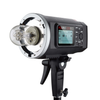






























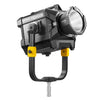

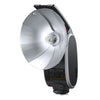
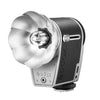
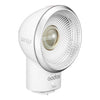
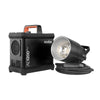
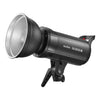
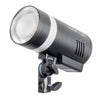
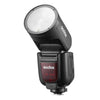
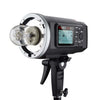
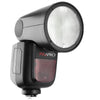

















































Godox AD600Pro II vs the new Godox AD800Pro
With similar sizes and shapes, the AD600Pro II and the newly announced AD800Pro from the Godox battery flash range may look like they produce the same result. So what are the real differences between these two photography flashes?
Power & Light Output
The key difference between the two flashes, the AD800Pro has 33% more power at 800 Ws vs 600 Ws on the AD600Pro II. Higher output = more power for overpowering sunlight, using larger modifiers, and for shooting motion. If you need more kick from your light, the AD800Pro is the first port-of-call.
As a result, the guide number is higher on the AD800Pro (~110 m) vs ~87 m on the AD600Pro II. However, both flashes also have a 10-stop power range for maximum adjustment down to 1/512th power making them both super versatile in lower light situations.

Flash Duration
Fastest durations are similar overall, especially in normal mode where they both hit at at 11,400 and 11,740 respectively, but Freeze Mode is where it really happens. The AD800Pro’s “freeze” mode goes slightly shorter at the extremes (up to ~1/35710 s) vs ~1/20400 s on the AD600Pro II, making it beneficial when freezing super fast action.
Recycle Times
The AD600Pro II can recycle faster at full power (~0.9 s max) compared with AD800Pro’s ~1.5 s, though both can be much faster at reduced power settings. This is great for things like dance photography where you need to keep firing to not miss the moment.
Battery Capacity
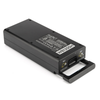
Due to it's higher output, the AD800Pro uses a slightly larger battery (~2900 mAh) than the AD600Pro II (~2600 mAh), but produces fewer flashes per full charge at around 300, vs the AD600's 360 flashes due to it's lower overall output.
Modelling Lamp & Controls
Both feature a 40 W bi-colour LED modelling lamp, standard 2.4 GHz wireless control with 16 groups & 32 channels (with colour coded groups too!), and colour displays.
Both flashes also have the standard Godox 2.4GHz receiver built-in, and the new X3 trigger one-tap connection!

Choose AD600Pro II if:
- You want lighter weight and more flashes per battery charge at 600 Ws.
- You often shoot in studios or smaller location setups where max power is less critical.
Choose AD800Pro if:
- You need extra output (800 Ws) for overpowering bright sunlight or when using heavy diffusion.
- You want slightly shorter fastest flash durations for action-freezing and broader creative flexibility.
Check out our full specifications comparison below
| Feature | Godox AD600Pro II | Godox AD800Pro |
|---|---|---|
| Power Output | 600 Ws | 800 Ws |
| Guide Number (ISO 100) | ~87 m | ~110 m |
| Power Control | 10-stop (1/1–1/512) | 10-stop (1/1–1/512) |
| Flash Duration (t0.1) | Normal: 1/220s–1/11760s, Freeze: up to 1/20400s | Normal: 1/350s–1/11400s, Freeze: up to 1/35710s |
| High-Speed Sync | Up to 1/8000 s | Up to 1/8000 s |
| Battery | 28.8 V / ~2600 mAh Li-ion | 28.8 V / ~2900 mAh Li-ion |
| Full-Power Flashes per Charge | ~360 | ~300 |
| Recycle Time | ~0.01 – 0.9 s | ~0.01 – 1.5 s |
| Modelling Lamp | Yes (40 W bi-colour) | Yes (40 W bi-colour, CRI ~97 / TLCI ~98) |
| Display | Colour screen | Colour screen |
| Wireless Groups/Channels | 16/32 | 16/32 |
| Weight (with battery) | ~3.5 kg | ~3.7 kg |
| Typical Use | Studio / location with lighter payload needs | More power for strong daylight / large setups |


